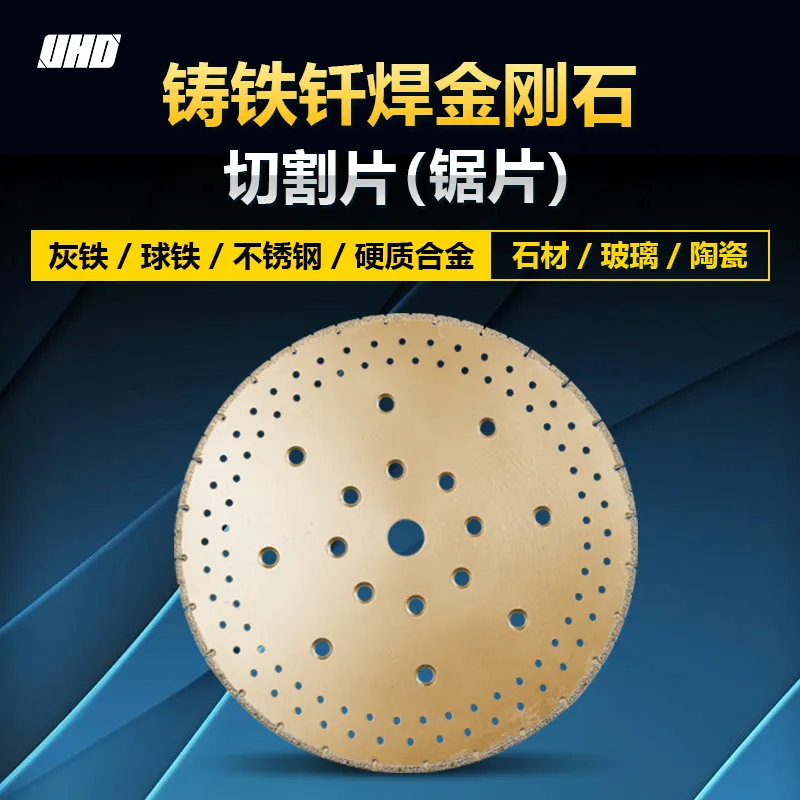
When it comes to industrial cutting, the durability of saw blades is a crucial factor. Why are imported saw blades often more durable? Let's take a closer look at the diamond particle oriented arrangement technology behind the Youde Super - hard 400H brazed diamond saw blade.
The distribution density and oriented arrangement of diamond particles in the matrix play a vital role in the cutting efficiency, wear resistance, and service life of the saw blade. Think of the diamond arrangement as a well - planned road network. Just as a well - designed road can ensure smooth traffic flow, a scientific diamond arrangement can significantly enhance the cutting performance.
When diamond particles are evenly and densely distributed in the matrix, they can effectively share the cutting force. This not only improves the cutting efficiency but also reduces the wear on individual particles, thereby extending the overall service life of the saw blade. For example, in a saw blade with proper diamond distribution, the cutting speed can be increased by up to 30% compared to those with random distribution, and the wear rate can be reduced by about 20%.
There are two main brazing technologies in the production of diamond saw blades: silver - copper alloy brazing and vacuum brazing. Silver - copper alloy brazing is a traditional method that is relatively cost - effective and suitable for some general - purpose cutting applications. However, it has limitations in high - temperature stability and bonding strength.
On the other hand, vacuum brazing offers significant advantages. In a vacuum environment, the brazing process can achieve better high - temperature stability and stronger bonding strength. The bonding strength between the diamond particles and the matrix can be increased by about 40% compared to silver - copper alloy brazing. This means that the saw blade can maintain its integrity even under high - temperature and high - pressure cutting conditions, effectively preventing particle shedding.
"Vacuum brazing is a game - changer in the field of diamond saw blade manufacturing. Its ability to provide strong bonding and high - temperature stability is crucial for high - performance saw blades," said an industry expert.
Let's look at some real - world failure cases. In a metal cutting factory, a saw blade experienced severe particle shedding during the cutting process. After investigation, it was found that the root cause was the improper brazing process. The use of silver - copper alloy brazing in a high - temperature cutting environment led to the weakening of the bonding between the diamond particles and the matrix, resulting in particle shedding.
Another common problem is uneven wear, or "偏磨" in Chinese. This often occurs when the diamond particles are not properly arranged. For example, if the diamond particles are concentrated on one side of the saw blade, that side will wear out faster, leading to uneven cutting and reduced service life.
By understanding the differences in core manufacturing processes, users can identify high - quality products from the source. When choosing a diamond saw blade, it is essential to consider the distribution of diamond particles and the brazing technology used. Youde Super - hard 400H brazed diamond saw blade, with its diamond particle oriented arrangement technology and vacuum brazing process, is a reliable choice for industrial cutting applications.
Are you looking for a saw blade that offers high cutting efficiency and long service life? Click here to learn more about Youde Super - hard saw blades and choose the right brazing solution for your working conditions!
 Multi - material cutting techniques
Diamond saw blade usage tips
Stone processing parameter optimization
Youde Superhard saw blade application
Saw blade life extension methods
stone cutting efficiency
cross-material cutting
diamond saw blade optimization
marble cutting techniques
granite saw blade
brazed diamond saw blades
stone cutting tools
diamond blade selection guide
ISO certified industrial blades
high-performance cutting solutions
Brazed diamond saw blade
Granite precision cutting
Saw blade vibration reduction technology
Feed rate control
Fixture fixing skills
concrete cutting vibration reduction
brazed diamond saw blade
dynamic balance calibration
elastic connectors
construction safety enhancement
Multi - material cutting techniques
Diamond saw blade usage tips
Stone processing parameter optimization
Youde Superhard saw blade application
Saw blade life extension methods
stone cutting efficiency
cross-material cutting
diamond saw blade optimization
marble cutting techniques
granite saw blade
brazed diamond saw blades
stone cutting tools
diamond blade selection guide
ISO certified industrial blades
high-performance cutting solutions
Brazed diamond saw blade
Granite precision cutting
Saw blade vibration reduction technology
Feed rate control
Fixture fixing skills
concrete cutting vibration reduction
brazed diamond saw blade
dynamic balance calibration
elastic connectors
construction safety enhancement






.png?x-oss-process=image/resize,h_100,m_lfit/format,webp)
.png?x-oss-process=image/resize,h_100,m_lfit/format,webp)
.png?x-oss-process=image/resize,h_100,m_lfit/format,webp)



.png?x-oss-process=image/resize,h_800,m_lfit/format,webp)