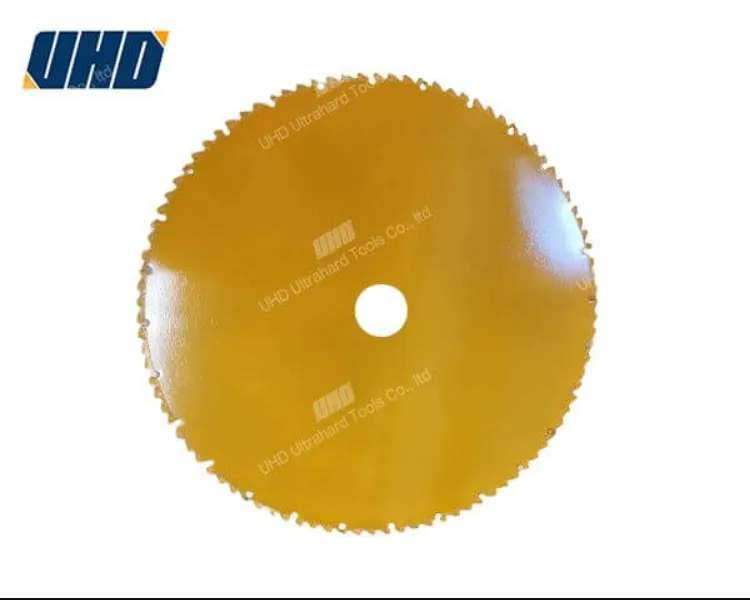
Industrial diamond saw blades, such as the Youde Super-hard 400H brazed diamond saw blade, play a crucial role in construction, stone processing, and other industries. However, ensuring their long - term performance requires a comprehensive maintenance management plan. This article will delve into the full - cycle management of industrial saw blade maintenance, from daily upkeep to replacement criteria.
In practical applications, industrial diamond saw blades often encounter various faults. For example, thermal damage is a prevalent issue. Excessive heat during cutting can cause the diamond particles to deteriorate, reducing the cutting efficiency. Research shows that for every 100°C increase in the cutting temperature, the wear rate of the saw blade can increase by approximately 20%. The cause of thermal damage is usually related to high cutting speeds, improper feed rates, or insufficient cooling.
Particle detachment is another common problem. When the bonding strength between the diamond particles and the matrix is insufficient, the particles may fall off during cutting. This is often due to improper manufacturing processes or the use of low - quality materials. According to industry statistics, about 30% of saw blade failures are related to particle detachment.
Eccentric wear occurs when the saw blade does not rotate evenly around its axis. This can lead to uneven cutting and reduced service life. Poor installation, improper clamping, or mechanical damage to the saw blade can cause eccentric wear. In some cases, eccentric wear can reduce the saw blade's service life by up to 50%.
Proper daily maintenance is essential for extending the life of industrial saw blades. After each use, the saw blade should be cleaned to remove debris and coolant residues. A soft brush can be used to clean the saw blade gently. It is recommended to clean the saw blade every 8 - 10 hours of use to prevent the accumulation of debris, which can affect the cutting performance.
When storing the saw blade, it should be placed in a dry and clean environment. Hanging the saw blade on a special rack can prevent deformation. Avoid stacking saw blades on top of each other, as this can cause damage to the cutting edges. Additionally, it is advisable to cover the saw blade with a protective film to prevent oxidation and corrosion.
There are several practical techniques for diagnosing the condition of a saw blade. One method is to listen to the sound during cutting. A normal saw blade produces a relatively stable and continuous sound. If there are abnormal noises, such as screeching or rattling, it may indicate problems such as particle detachment or eccentric wear.
Another way is to observe the cutting effect. If the cutting surface becomes rough, or the cutting speed decreases significantly, it may be a sign that the saw blade needs maintenance or replacement. For instance, if the cutting speed drops by more than 15% compared to the initial speed, it is time to check the saw blade carefully.
The Youde Super - hard 400H brazed diamond saw blade stands out for its high - quality performance. It uses advanced brazing technology, which provides a stronger bonding force between the diamond particles and the matrix, significantly reducing the probability of particle detachment. The unique design of the saw blade also helps to improve heat dissipation, effectively preventing thermal damage.
In addition, Youde offers comprehensive technical support and after - sales service. Their team of experts can provide professional advice on saw blade selection, installation, and maintenance, ensuring that customers can make the most of the saw blade's performance and extend its service life.
Are you looking to enhance the longevity and performance of your industrial saw blades? Discover the superior quality and technical support of the Youde Super - hard 400H brazed diamond saw blade. Click here to learn more!


 tool failure diagnosis
metal machining downtime
diamond tool vibration issues
cutting parameter optimization
machine maintenance best practices
Youde Superhard 400H brazed diamond saw blade
Diamond saw blade wet and dry cutting
Diamond saw blade life extension
Saw blade common faults and maintenance
Construction and stone processing saw blades
Brazed diamond saw blade
Granite precision cutting
Saw blade vibration reduction technology
Feed rate control
Fixture fixing skills
400mm brazed diamond saw blade
concrete cutting blade
granite cutting tool
diamond blade heat dissipation design
stone processing saw blade
diamond blade vibration control
tile cutting precision
anti-vibration blade design
hard material cutting optimization
cutting stability improvement
tool failure diagnosis
metal machining downtime
diamond tool vibration issues
cutting parameter optimization
machine maintenance best practices
Youde Superhard 400H brazed diamond saw blade
Diamond saw blade wet and dry cutting
Diamond saw blade life extension
Saw blade common faults and maintenance
Construction and stone processing saw blades
Brazed diamond saw blade
Granite precision cutting
Saw blade vibration reduction technology
Feed rate control
Fixture fixing skills
400mm brazed diamond saw blade
concrete cutting blade
granite cutting tool
diamond blade heat dissipation design
stone processing saw blade
diamond blade vibration control
tile cutting precision
anti-vibration blade design
hard material cutting optimization
cutting stability improvement






.png?x-oss-process=image/resize,h_100,m_lfit/format,webp)
.png?x-oss-process=image/resize,h_100,m_lfit/format,webp)
.png?x-oss-process=image/resize,h_100,m_lfit/format,webp)